
DELE Levels Explained: Which One to Register For
October 10, 2026 · 3 min read
DELE isn't one adaptive test - you register for and pay for a specific level (A1 to C2) before you sit anything. Here's how to pick the right one, and how the exam is actually scored.
Bu yazıyı Türkçe okuyun
With most exams you sit one test and get a score on a scale. DELE doesn't work that way. You choose and pay for a specific level - A1, A2, B1, B2, C1, or C2 - before you sit anything, and you only get a pass or fail for that level. Pick the wrong one and you either fail a level you were never close to passing, or pass a level too easy to prove what you actually need. Here's how to pick correctly.
Six exams, not one scale
DELE (Diplomas de Español como Lengua Extranjera) is issued by the Instituto Cervantes on behalf of Spain's Ministry of Education. For adult candidates there are six separate diplomas, one per CEFR level: A1, A2, B1, B2, C1, and C2. Each is registered, scheduled, and certified as its own exam - there's no single "DELE score" that places you somewhere on a continuous scale the way a TOEFL or IELTS score does.
Practically, that means the decision that matters most happens before you ever open a practice test: which of the six do you register for.
- Does a university or employer require a specific level?
- Yes
- Register for that exact level
- No
- Take a CEFR self-assessment or diagnostic test
- Register for the level that matches it, or one below if unsure
- Yes
What each level actually certifies
The Instituto Cervantes maps every DELE level directly onto the CEFR scale. Here's what each one is meant to demonstrate:
- A1 - basic, everyday phrases and simple needs (introducing yourself, shopping, simple directions).
- A2 - straightforward communication on familiar, routine topics.
- B1 - independent handling of most everyday situations, including some unfamiliar ones.
- B2 - fluent enough to discuss abstract and complex topics, including in a professional setting.
- C1 - fluent and spontaneous use of the language in demanding academic or professional contexts.
- C2 - near-native command, including subtlety and nuance in virtually any context.
How the exam is actually scored
Every DELE exam from A1 to B2 is scored out of 100 points, split across four skills worth 25 points each: Reading comprehension, Listening comprehension, Written expression and interaction, and Oral expression and interaction. The four are grouped into two blocks - Reading + Writing, and Listening + Speaking - and you need at least 30 of the 50 points in each block to pass. A strong Reading score cannot offset a weak Speaking score, because they sit in different blocks.
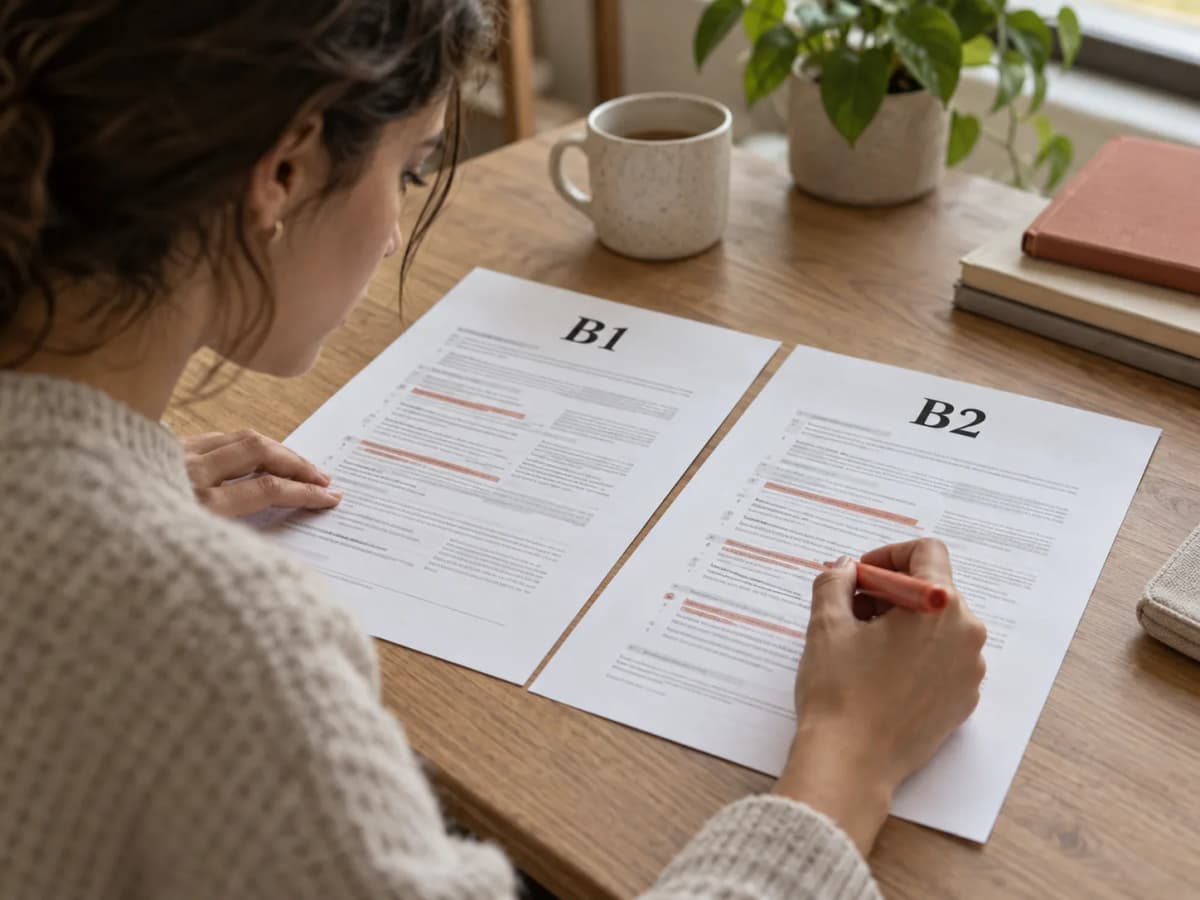
This is also why "which level" matters more for DELE than for an exam with one adaptive scale: if you register for B2 and your real level is a strong B1, you don't get a B1 pass certificate as a consolation prize. You get a B2 fail, a result that says nothing certifiable about what you can actually do in Spanish, and a fee you'll need to pay again.
Matching your level to what you'll actually use the diploma for
If a specific institution has already told you the level they require - a university programme, a residency or citizenship application, an employer - register for that exact level. Don't round up "to be safe": a higher level you're not ready for is simply a harder way to fail, not a stronger proof of ability.
If nothing external has specified a level yet, the more reliable approach is a CEFR-based diagnostic or placement test first, then registering for the level it points to - or one level below it if the result sits right on a boundary. Spanish-language skills are graded independently in each of the four areas, so a candidate who is strong in Reading but weak in Speaking should weight their practice time toward Speaking specifically, not assume their stronger skills will carry an average.
What to actually do with this
Before registering, settle two things in order: first, whether any institution has already fixed your required level - if so, that decision is made for you. Second, if not, take an honest CEFR-based diagnostic and register for the level it supports, remembering that each of the four skills is graded separately and none of them can cover for another.
Message us on WhatsApp to book a free trial lesson, and we'll help you work out your real CEFR level skill by skill before you commit to a DELE sitting.
This article is based on official Instituto Cervantes guidance on DELE exam levels, structure, and scoring. Exact fees, dates, and registration deadlines are set and updated by the Instituto Cervantes - always confirm current details on the official exam site before registering.
Further reading:
Ready to put this into practice?
Book a free trial lesson with a certified teacher.
Book my free lessonMore articles

October 8, 2026 · 3 min read
What TestDaF Score Do You Actually Need for University?
TestDaF gives four separate TDN scores, not one overall band. Here's what TDN 3, 4 and 5 actually mean, and the real score German universities expect.
October 6, 2026 · 2 min read
A2 Key Paper Test Ending: What to Book Instead
Cambridge English confirmed the last paper sitting of A2 Key: Thursday 3 December 2026. What's actually withdrawn, what isn't, and which exam to book in its place.
October 6, 2026 · 5 min read
Why Retaking IELTS Doesn't Raise Your Score
IDP IELTS's own guidance names the real reason retakes stall: practising the same mock tests without checking your actual writing and speaking against the band descriptors. Here's what that means in practice.